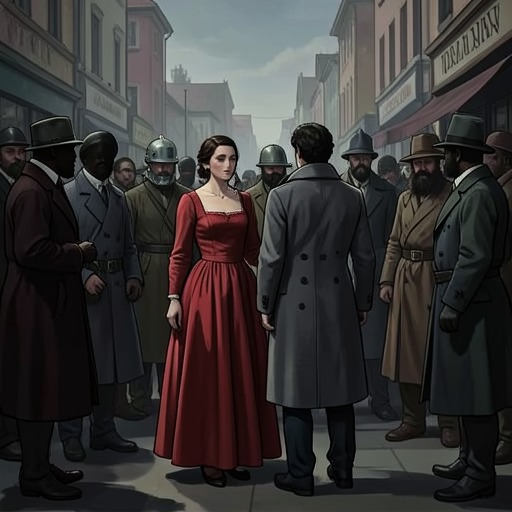
Adrián Gallardo's murder and the burial of his body
Los pacientes del doctor GarcíaAdrián Gallardo's murder and the burial of his body is the turning point at which Guillermo García Medina, a doctor committed to saving lives, deliberately kills a man he regards as an imminent threat. Gallardo’s death is then absorbed into a second violence: the concealment of his identity and the removal of the body from ordinary legal scrutiny. The episode links a personal decision, made in the name of protecting others, to the machinery of impunity that makes an unrecorded death possible.
Discovery and the threat of exposure
The crisis began when the real Adrián Gallardo found Rafael Cuesta Sánchez, the identity under which Guillermo García Medina was living, at the transport agency where he worked. Gallardo understood that someone with his own name was impersonating him. Guillermo did not deny the essential fact: he had a friend who shared Gallardo’s name, and he proposed a discreet meeting rather than discussing the matter at the office. He also offered Gallardo money. Gallardo, who had not initially considered blackmail, saw that surrendering his identity could be profitable.
The danger was more than embarrassment or exposure. Manuel Arroyo Benítez had taken Gallardo’s identity to infiltrate a network helping Nazi fugitives and to travel to Argentina as one of them. If the real Gallardo disclosed the deception there, Manuel might not survive a day. The discovery also threatened the committee Burnstein, people connected to the operation, and Guillermo’s own future. The false identity, which had enabled Manuel’s work, had become a vulnerability precisely because its rightful bearer was still alive.
The decision to kill Gallardo emerged through discussion rather than an immediate outburst. Guillermo first considered whether Gallardo could be frightened or paid off, but Rolf Steinbauer rejected that course: Gallardo was too dangerous, and they could not live waiting for him to talk. Guillermo asked whether Steinbauer could speak with Hans, then offered to do the killing himself. He describes the choice as a decision to protect what he loved, not as revenge or an effort to pose as a just avenger. That distinction does not undo the act; it shows how he recasts a deliberate killing as a defensive necessity.
Preparation and the killing
Guillermo had already spent time considering the practical obstacles. He had no car, did not want to involve Communist friends who were under police surveillance, and judged that bringing Meg Williams into the secret would expose her to matters Manuel had withheld from her. He needed not only a means of killing Gallardo but support for disposing of the body. The planning makes the change in his role concrete: a doctor who had once been forbidden by Dr. Quintanilla to enlist outside the hospital’s surgical service now reasons through the logistics of an assassination.
On 28 December, Guillermo inspected the office of the Sociedad Europea de Comercio Exterior, measuring the spaces between furniture and identifying what the room could conceal. In a wooden inlaid chest on the windowsill, he found the loaded .22-caliber Luger, spare ammunition, and a silencer that Rolf Steinbauer had provided. The key was hidden inside the fourth volume of Goethe’s complete works in Spanish, on the fourth shelf. Guillermo fitted the silencer and discovered that a concealed recess beneath the desk could hold the weapon ready to hand. The respectable office furniture and literary volumes thus served a double purpose: ordinary furnishings masking the preparations for murder.
On 29 December 1949, Guillermo arrived at the office at seven in the evening. His account places the killing after Gallardo’s unannounced appearance and after Guillermo had settled on the plan. He acknowledges that the real Gallardo had ceased to seem like a person to him: Guillermo had begun to think of him as a dangerous creature who had to disappear. The narrative presents that dehumanizing judgment as part of the path to violence, while also making clear that Guillermo knew what he was doing. He later says that he killed Gallardo in cold blood and that no judge, in his view, would have accepted a claim of self-defense, even though he believed such a denial would be wrong.
An unidentified body
On New Year’s morning, the shepherd Zacarías González Peña found a body in a hollow in Casa de Campo, where he had brought sixty-eight sheep. Unlike the bodies he had found there over the preceding five years, this one had been wrapped in a carpet. It was still clean despite the wound in the man’s neck; when Zacarías unrolled it, the body rolled onto its back, revealing the left wrist. The carpet’s elaborate pattern partly obscured the blood, making the wrapping itself an instrument of concealment.
The dead man was between thirty and thirty-five years old, about 170 centimetres tall, with dark brown hair and a robust build. His nose had been broken, the only distinguishing feature the investigators could identify. He wore a grey suit, white shirt, and dark overcoat, but had nothing in his pockets: no wallet, papers, or coins. The absence of documents meant that the body arrived at the authorities without a name, while the broken nose offered only a possible clue, not an identity.
Inspector Roberto Conesa recognized that this was not an accidental death or a drunken shooting. The body showed none of the resistance injuries—bruises, scratches, or broken nails—that might mark a struggle. A single shot beneath the jaw had ruptured the left carotid; the position of the wound and its appearance indicated a silencer. Conesa concluded that the victim had either been taken unawares or been too frightened to resist. He suspected a policeman or soldier using an unregistered weapon, but could not identify the killer. Rather than expose the crime to judicial scrutiny, he chose to contain it.
Administrative disappearance
Conesa told the other officers not to make a formal report and took the body to the forensic institute himself. A young on-duty examiner fixed the approximate time of death as the afternoon of 29 December. Conesa and the examiner agreed to omit the autopsy, which would delay burial, and the body was dressed again and left at the depot. A police report was attached to the death certificate in an envelope pinned to the sack. Conesa described his paperwork as routine; his superior congratulated him and said he would handle the rest. By the next day the body had been buried, and Conesa reflected that nothing made police work easier than a dictatorship.
At around seven that evening, the body reached the old Eastern Cemetery, by then renamed La Almudena. An official assigned it to the crew burying unidentified people in a common grave. The decade’s many undocumented dead, the narrative notes, had acquired the curious habit of dying from the same cause: cardiac arrest, with no further details supplied. Gallardo’s fatal bullet wound was thus administratively translated into a bland, familiar cause of death. The grave did not merely hold an unknown man; the records helped make his unknown status seem ordinary.
Even the cemetery’s handling of the body followed the logic of disposal. The foreman told the gravediggers to remove the corpse from its sack because the sack had to be returned; such things cost money. One worker proposed taking the new overcoat because the dead man no longer needed it, and another agreed, suggesting they hide it in a locker and gamble for it. The men noticed the bullet wound, but their attention also turned to the coat’s quality. That small, material detail completes the process of reduction: the unidentified victim becomes first a body to bury, then a useful garment.
Significance and the widening pattern of erasure
The murder is bound to the episode’s larger concern with concealed identity. Manuel’s survival and undercover work depend on living as Adrián Gallardo; the real Gallardo’s presence makes the borrowed identity unstable and dangerous. After Guillermo kills him, the empty pockets, the withheld report, the omitted autopsy, and the common grave extend that instability into the official record. The crime is not simply hidden by a single lie: a sequence of decisions strips away the means by which the dead man might be named and his death contested.
The episode also draws a moral contrast between the state’s claimed order and the practical freedom it gives its agents. Conesa recognizes an execution and suspects an armed state functionary, yet chooses not to report the murder because he believes the perpetrator will never be found and that declaration would bring risks without benefit. His superior’s approval and the rapid burial show how institutional cooperation can make deliberate violence disappear without requiring a public order to kill. The state’s power lies here not only in the capacity to take life but in controlling which deaths become legible.
That mechanism recurs elsewhere in the novel’s historical account, though on a different scale. During the Argentine dictatorship, clandestine groups divided the work of kidnapping, detention, torture, execution, disposal of bodies, and concealment of stolen children’s identities; the estimated number of disappeared people reaches about thirty thousand. The Spanish episode is not equivalent in scale, but its sequence—an execution, an unrecorded identity, official obstruction, and burial under a false cause—makes the later system intelligible as a radical expansion of a logic already visible in the earlier story. In both cases, violence aims beyond the victim’s body: it seeks to deprive survivors and investigators of the facts needed to establish that a person existed and was killed.
For Guillermo, the act also marks the cost of defending a network and a friend through the very violence he had once opposed. He continues to understand himself as a man whose calling is to save lives, but on this occasion he deliberately kills because he believes there is no other way to protect Manuel, the operation, and the people at stake. The burial completes the practical concealment of that choice, not its moral resolution. Gallardo disappears from the records as thoroughly as his identity had threatened to return, leaving Guillermo’s self-justification and guilt in tension with the impunity that has made both possible.